Friday, May 17, 2013

Yarn happenings

Here's what's going on with me.
Several different things, as usual. I haven't stopped spinning, I've just had less opportunity to share photos and stories. This is yarn for the third ring of a wonderful, international handspun swap I've been doing. Two different people spun and knit the first two rings, and I add my own third - meanwhile, I spun and knit two other rings that went to two other people, in Cardiff and Washington State.
The two rings I received are from Virginia and Colorado, and they're beautiful and very soft. I started to knit the third ring yesterday while out and about, but forgot to bring the first two with me - doh! The third ring has to be linked into those two when you join to knit in the round - it's a Russian Wedding Ring Cowl (Ravelry link). 

In other news, I'm getting ready to go to Laos for 6 weeks (!!!!) for my conservation degree placement. I will be working with the Ock Pop Tok organization on their collection of traditional woven textiles.  Hoping to finish weaving the handspun cotton below, and take it with me, to break the ice with the Lao women. Also hoping the local weavers don't laugh too hard when they compare my skills to their own.
 In case I don't find all the right sticks immediately, I'm taking my 'loom' with me. It looks like this:
 As long as I can get ahold of, or make, some yarn, I'll be ready to weave. I'm not planning to take my little rigid heddle - they make such things over there, and I will be on the hunt in the market, and/or weaving without one, which is my normal method.

From the department of Learning Something New, I've been attempting to spin like a Portuguese woman. Or like a Greek, Sardinian, French, Spanish, Medieval European.... I've noticed that a huge percentage of images, historical and contemporary, show women spinning with distaff and vertical spindle held by the tip, without necessarily dropping or letting go. It's counterintuitive for someone who learned on a top-whorl drop spindle with a hook, but I'm trying to get the hang of it. I started with a prepared top, and then changed to hand-picked locks, shown below. Everything on that spindle has been spun in this way, for what it's worth. It is not high-quality yarn, I can tell you that. But it's maybe, maybe getting better.
- spindle made by the same woman who spun the cotton yarn warp I'm weaving, and made the rigid heddle - my buddy Janet who is brilliant but doesn't sell them so don't ask ;)

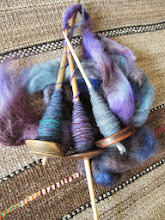
Recently I had an impulse spin, after hearing about various kinds of suffering among people who are dear to me. Spun up some healing, in the form of supersoft fibers that felt loving and warm as I spun.

And one more fun thing: YarnWench wildcard bling batt, spun on an antique Iranian spindle = whee!


Friday, May 10, 2013

Spinning from the cloud

 ...has never seemed so literal before.  How lovely and inviting is this cloud, made of locks dyed by Laura Mayotte of the prolific indigo vat.
Life requires me to spin right now, which means life is good.

Saturday, April 6, 2013

Recipe for sanity

Stay in a house open to the outdoors
Ride a train through a green country
Be surrounded by an unknown language
And if you're really serious about it, throw in a 
This recipe worked for me, and I liked Sri Lanka 
even better this second time around.

Friday, January 25, 2013

Outdoors

This is the time of year when we can relish living in Doha. Balmy days, clear blue skies.
And I'm finally back to this again - maybe coincidence, or maybe the chance to work outdoors?
Here's my view while weaving:
And here's what I looked like (with thanks to anonymous Filipino guy who took the photo):
A better version of the view, since it's crooked in the first photo. Here's the Doha skyline these days.
And just for fun, a comparison with 2008:


Tuesday, January 15, 2013

Linen. Old.


Ancient Egyptian linen. I got to look at some, up close.

Having recently read Barber's description of linen splicing in Prehistoric Textiles, I knew that the places that looked plied were most likely spliced, and these spots were visible here and there in the woven cloth. There's one going across in the photo below, just below the center of the image. If it works to click on these photos and see them bigger, you may be able to find more splices in other images.
I found a blue striped border, which recurred in several fragments. As you can see, the weave is warp-dominant - probably because the weaving was done on ground looms (as per Barber.)
Similar designs were displayed in the British Museum:
I found some fringe, and a seam, both of which may be part of the "additional tunics" mentioned in the conservation article from 1979.
That's the view of the seam that was on the inside, as the fabric lay in storage. On the other side, there is some lint along the fold, which I found very interesting - what would the lint be made of? It looks fluffy, like wool. And how old would the lint be? Ancient Egyptian lint? Or storage lint?
And here's an absolutely perfect selvedge, top of the photo below. It's not folded or anything - it's that straight.
The bulk of the perfect-selvedge cloth looked like this, with some uneven spaces between warps.
I could not decide if this was a result of deterioration or distortion from long years crumpled in storage, or if it appeared this way when it was originally woven. (The dark spot up top is a hole.) Anyway, I let the unevenness encourage me, since my current backstrap weaving has a lot of variation in the space between warps.
There was a wide range of density-to-lightness in the fabrics, with the linen threads also thicker in some cloth and finer in others. Here are two quite different piece, the upper one much lighter and finer.
Did I wish I could open each of these out and see the full size and shape and speculate more about their purpose? Of course I did! However, I was asked to disrupt them as little as possible, and truly any amount of unfolding risked further disintegration, so this was not the time to sort them all thoroughly. I was hoping that someday someone will, though.
Here is a knot. Just because it's there.
And finally, the Gurob sleeves (listed with other things on this helpful website), which I looked at (in a case, with the aid of a museum-provided flashlight/torch) after having examined the other linens. I was happy to see that I could make out the spliced sections on this fabric, which is much more finely and densely woven, and well-preserved. Beautiful seams, too.
These child-sized sleeves were made separately, to be attached to a sleeveless tunic as needed. This was apparently the custom, since Egypt is usually hot and most clothes were made sleeveless. I'm thinking the sleeves are densely woven because they are a warm layer for the cold season.
My appreciation for ancient linen production grew immensely that day.


Questions and comments welcome - don't be shy.

Saturday, January 5, 2013

Puttering, or a post to prove I'm alive


It feels so nice to putter again. I’ve just had a good hour or so of puttering about the apartment. When school is on, I don’t have time, and as soon as the winter break began, I got completely ill with a bad cold. Then I left town for two weeks, so had not had a good putter in ages.

After being away, it’s like a little ritual of attention, re-establishing the familiar order of things, adjusting the arrangement of the space in small ways (or bigger ways when, as now, my husband has been dealing with electrical problems and a daily parade of workmen in my absence.)

It’s very gratifying to get a bunch of normal, necessary things done, like wiping down the kitchen, putting away dishes, starting laundry, unpacking, making a grocery list. Nothing the least bit remarkable, but in the week before I left I was too sick to do any of it, which made me a little crazy, and so just being able to productively putter is so nice.

And the sooner I’ve done the right amount of puttering, the sooner I can dive back into spinning and weaving, which projects are calling out to me enticingly.

Then I can also talk about all the things I saw in London, like 5000-year-old linen,
and a spontaneous demonstration of North Ronaldsay fleece de-hairing in the British Museum atrium, courtesy of Sarah Wroot.


Saturday, November 3, 2012

Mentor

(Judith Mackenzie and Velma Root - with kuchulus - at GGFI 2010)

During a week off school, I have been prioritizing fiber work and revitalizing the weaving part of my life. This poor neglected warp seemed almost dead, in spite of its bright colors. It had been lying around  collecting dust until I finally removed it from the dining table (ie, loom) not long ago, in order to clean and be free from the guilt of ignoring it. But this break, I tied it up and passed the shuttle and it breathed back to life - the sensation was quite palpable. Now it's off the loom because the weaving's DONE, and it's ready to be sewn into a conservation tool bag.
The reactivation of my weaving identity coincides with a whole lot of thoughts and supportive vibes pouring toward Judith, shown above. Her teaching studio burned down this week, and if I go into the details of the loss again it may make more than one of us cry, so I will carry on with this account of What Judith Means to Me.  I met Judith at Golden Gate Fiber Institute Summer Intensive, 2010, and she let me know I'm a weaver. I'm not a weaver because of Judith, but she recognized it and commanded me to get on with it.
 Judith took this photo of me weaving in her class, with part of my hair tied up in an indigo dye bun.
 My first 250-end warp, with Pony yarn, which included shibori and was dyed indigo like so:
In that class I also dyed this
 which became this
because, due to Judith's urging, I returned to Qatar and figured out how to set myself up with a backstrap in order to weave it.
And that was how it began, the weaving.  Because of Judith. And that phrase could be added to each of these things I wove, since she has remained a constant mentor in my mind, even though I have not communicated with her at all since that week at Point Bonita. Thanks to her encouragement, I keep weaving
 and weaving
 and weaving
So I feel distraught and a bit helpless when I think of her studio burning down, and all the precious material she has suddenly lost. When I first heard about it, my response was to weave. 
The community is responding quickly, a website has been set up, and there will be ways to help.  If an auction gets going, you can expect to see some of my handwoven items on the block.

I feel gratitude to Judith continuously, but now is the time to say it out loud and hope she hears it.