Wednesday, May 29, 2013

Fai: Lao cotton


When I came to Laos, I was hoping to see some cotton fiber preparation and spinning. The Living Crafts Centre being what it is, it did not take long to coordinate my interests with the needs of the centre. There is a cotton display that required attention, and women from a major cotton producing area were due in town. One of these women, Euay Navon*, came to demonstrate the various steps of the process, and I got to simultaneously document and learn from her.

Notice that she is beautifully dressed in all handspun, handwoven cotton, in several different types of material.
The cotton, she said, was not the best quality, because it hadn’t gotten enough sun to dry out after picking. She also showed how it can get damaged by rain, if the water gets inside the pod as the cotton grows (left damaged, right good). 
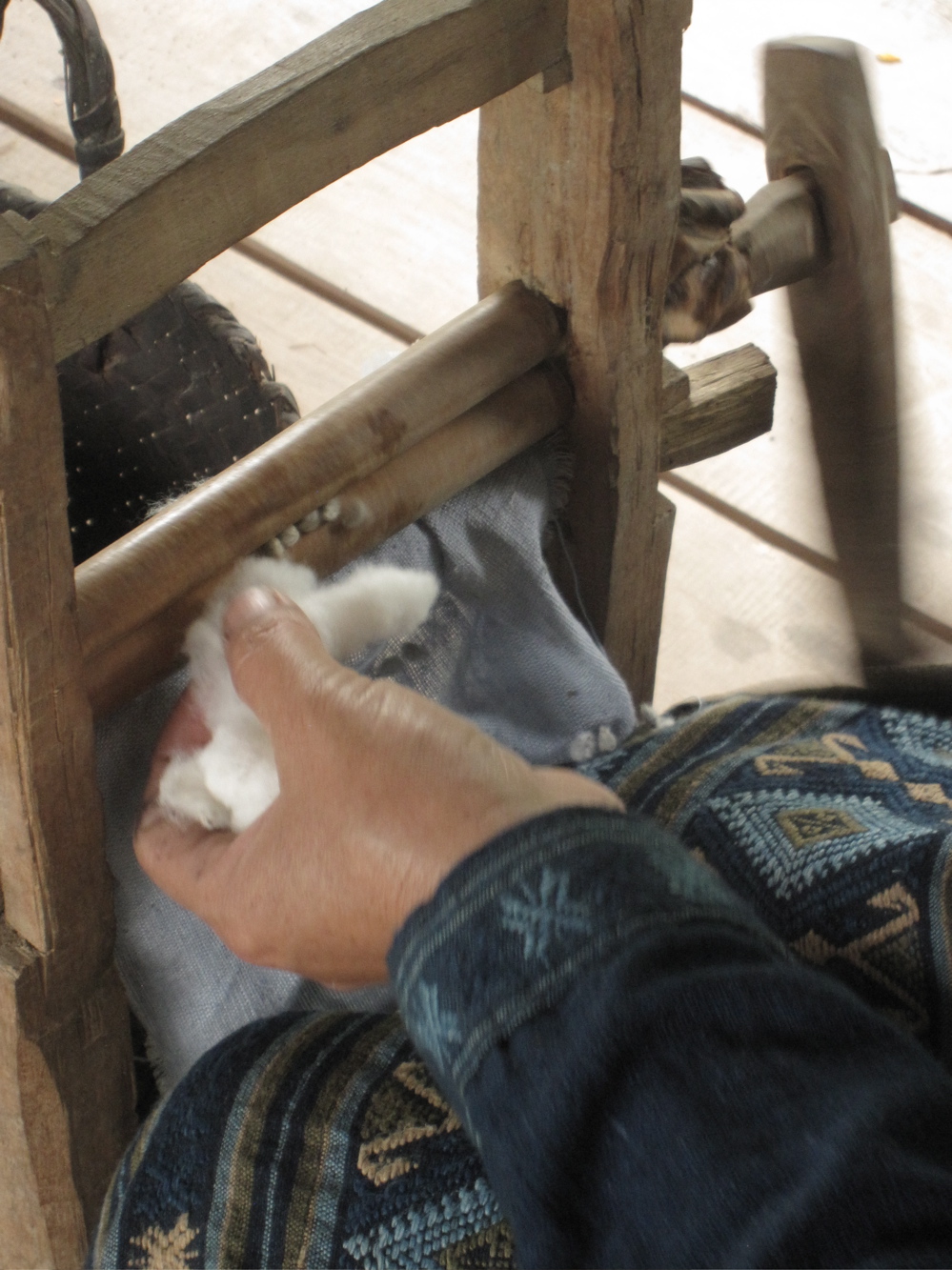
The bad parts have to be sorted out, then the seeds can be removed with a hand-cranked gin (eeuw in Lao). This was so much easier and faster than other seed-removing methods I’ve seen, such as the Ethiopian rolling of a stick against a stone to squeeze away the seeds.
The ginned cotton is then fluffed up using a bow (kâ gong) inside a horizontal barrel-shaped basket. This is similar, conceptually, to the bowing done in India by men who go around and re-fluff the batting of quilts. Somehow, the flicking of the bowstring teases the cotton apart, eventually making it into a nice, fluffy cloud. Some technique is definitely involved, and my clouds are not as fluffy as Euay Navon’s.

The cloud is separated into bits about the size of two handfuls, placed on a smooth surface, and rolled around a stick to form a cylindrical puni or fai lor. These are made nice and firm, tightly packed before the stick is removed.
Now we’re ready to spin on a wheel (), or technically a wheel-driven spindle, just like the Indian charka. The wheel is turned with the right hand while the cotton is spun long draw against the quill with the left hand, as with a charka or a great wheel. Euay Navon makes relatively short passes, not allowing the yarn to wind on too close to the quill before drafting back again. She is a patient teacher, and emphasized the importance of pulling quickly, straight back from the quill tip, with a slight vertical angle.
Trying this, I experienced that ‘leap of faith’ I’ve heard spinners talk about regarding long draw – at times, Euay Navon would pull my hand back for me, and it seemed so fast, and she’d make a cranking motion with her right hand, telling me to keep adding twist. That balance of speed and control is a delicate thing, and I only got it for brief moments before turning clumsy again.
The spun yarn is skeined on a niddy-noddy (piya), of which there is a beautiful example here at the Living Crafts Centre. I didn’t find it in time to get Euay Navon to demonstrate, but it has both sets of arms parallel, so they must wind on straight. Will research further….

Much of the weaving is done with singles, such as Euay Navon’s beautiful indigo plainweave shirt.
This was such a treat and a privilege, and now I practice my newly learned techniques to make the cotton display informative and authentic. Several of the silk weavers are also accustomed to working with cotton in their home villages, and they took to the ginning and bowing as soon as it was put on display. This is a good way to find out who has the knowledge: put the tools in front of them, and they can’t resist showing their stuff.


* Euay is a respectful Lao term of address, literally meaning 'older sister', which Euay Navon is to me, by just a very few years.

A short video of  this demonstration is on YouTube:
Lao cotton prep and spinning

Tuesday, May 28, 2013

More Katu

....because I just can't get enough of this weaving style, and Geo was wearing a skirt she wove today.
 Is this stunning, or what?
 And some pillows, displayed in the villa. I am definitely developing a soft spot for the Katu weaving.
    Probably because it's done on the backstrap - it appeals at a visceral level.

Sunday, May 26, 2013

Katu backstrap

It's amazing to be surrounded by weavers, and I was especially happy to find that there is backstrap weaving going on here. Keo, shown here, and her sister Mone have come from the south of Laos to work at Ock Pop Tok
I had seen the Katu style of textile before, because the traditional men's garments have weft twining, and they come up in image searches of 'weft twining.' Three of these loincloths are hanging in my room - I coincidentally got the room decorated in the Katu style.
There is another beautiful weaving, which has been used to cover a chair. (Photographed outside my room because the room is dark.)
Needless to say, I've been observing Keo's weaving as much as I can. Her foot-tensioned loom is warped with four metres of cotton which will be woven in a tubular manner, rotating around the loom beams. There are three shed sticks, and two string heddles. The extra sheds control the intricate warp float designs within the stripes (as seen in the chair details and the detail in the last post.) The string heddle is a simple, self-adjusting heddle wound around the warps, with no knots or other tricks. There is a safety line running through in case the rod slides out, because it's not even secured tightly at the ends. Notice there are no yarns holding her other shed sticks in place, and no second cross. She does not get up from weaving without carefully rolling the warp up, from the feet toward her.
Her feet flex and extend as she changes sheds, and also while she works the beads into place.
The beads are strung onto the weft thread, and counted out before she passes the shuttle.
She makes use of a finished piece (with weft twining, see?) to measure the size and number of beads needed for her flower motif.
The traditional weavings vary in design, color, and density of beading. The beaded part takes a lot more time, since they have to be counted, and worked into place one by one. The piece Keo is working on now is an Ock Pop Tok design, which will actually be split into two along the middle of the warp when it's finished, and used on two different skirts. It's more efficient to weave the two parts as one.
More pieces from the showroom at Ock Pop Tok, and one of the women working here has a very beautiful bag that is all patterned stripes and no beading, which I need to photograph. I have also uploaded a short video showing Keo weaving.

A further coincidence is that the ouerjan design on my Bedu bag, which I'm carrying here, reminded Mone of Katu designs - from a distance she thought there were beads in it! This hadn't even occurred to  me, but the effect is very similar.
Eventually I showed Keo photos of Bedouin weaving in Qatar. I had never dreamed, when I searched 'weft twining' months ago and came up with Katu images, that I'd be sitting with a Katu weaver and showing her imaged of Bedouin weft twining and saying, "See? Same as Katu."
I am living a textile fanatic's fantasy, and every day is full of awe and delight.

The rainy season began in earnest the same day - rain is audible in the background of part of the video.

Friday, May 24, 2013

Trying to keep up


 Some random textile input from the last day or so... handspun cotton on spools, which was being wound into a warp.
And an old woven piece made of cotton, in the traditional 'butterfly' pattern.
The same butterfly is being woven in silk. This is the reverse image, because the back side is on top while supplementary weft is being woven.
See? I'm underneath Kiang's loom, looking at the front of her weaving. (The other beautiful weaving is part of her sarong.)
The multi-colored supplementary wefts are wrapped by hand. Here's another example below, shown from the top (= back side of finished fabric.) It's as complicated as it looks.
Another kind of weaving being done here is... backstrap!!  I have met the backstrap weavers, all two of them, and have spent hours watching the weaving. They're from the south of Laos, and use foot-tensioned looms. More on that soon! For now, just a teaser photo of the typical weaving from that region:
And just because it's pretty, here's what was hanging in the garden, some silk dyed for weft ikat (mut-mee).


Wednesday, May 22, 2013

Settling in at Ock Pop Tok

 Already, on the first day, before sleeping at all after an overnight journey from Doha, I was surrounded by textile stimuli. I'm staying at the villa of Ock Pop Tok's Living Crafts Centre, for the time being, which means I'm in the thick of the beauty and creation.
Weavers are constantly at work all day, turning silk threads into supplementary weft pieces of extreme skill. There are discontinuous (photo below) and continuous supplementary weft works in progress, as well as weavings that incorporate mut-mee weft ikat. I've watched long enough to finally make sense of the vertical heddle storage system (photo above) that keeps the patterns for the supplementary weft handy. I had seen this before but had never quite understood how it worked.
This is the largest complicated piece in progress. Kiang's hands are a blur as she whips the weft threads through the shed, working her way across nearly a meter of warp width. I also met a backstrap weaver who taught me how to improve my fringe twisting by using a thigh roll (the ancient way of thigh spinning yarn, by the way.) I'm very bad at it, so I've been trying to practice.
The location cannot be beat - that's the Mekong River flowing by.
Oh, and I've already bought yarn:
That was all yesterday, the very day I flew in. Which is an incredible experience, in itself. If you ever fly into Luang Prabang, you want your camera handy before the plane even lands.
No wonder my head was spinning so much I could hardly sleep, in spite of the desperate need to catch up on a missed night.

Today I have observed, filmed, and slightly helped with winding a huge cotton warp, and learned how to tie a knot from the woman who was warping (Yes, a knot. Even for the most basic things, there's nothing like an experienced mentor to demonstrate an efficient way. And when it comes to knots in warps, I want to learn from the most experienced people possible.)
I've also done some cotton spinning on a charka - !! If I knew they had charkas sitting around, I would have brought all my cotton. But that can also be found, I'm sure.
Shared my backstrap weaving projects with Kiang, of the super complex weaving above, who has seen such weaving because she went to an event in Santa Fe and got to meet weavers from South America.

So far I've learned at least one new thing and made at least one new friend a day. My mind may never settle, but that may be a good thing.

Here's where I am: Ock Pop Tok

Friday, May 17, 2013

Yarn happenings

Here's what's going on with me.
Several different things, as usual. I haven't stopped spinning, I've just had less opportunity to share photos and stories. This is yarn for the third ring of a wonderful, international handspun swap I've been doing. Two different people spun and knit the first two rings, and I add my own third - meanwhile, I spun and knit two other rings that went to two other people, in Cardiff and Washington State.
The two rings I received are from Virginia and Colorado, and they're beautiful and very soft. I started to knit the third ring yesterday while out and about, but forgot to bring the first two with me - doh! The third ring has to be linked into those two when you join to knit in the round - it's a Russian Wedding Ring Cowl (Ravelry link). 

In other news, I'm getting ready to go to Laos for 6 weeks (!!!!) for my conservation degree placement. I will be working with the Ock Pop Tok organization on their collection of traditional woven textiles.  Hoping to finish weaving the handspun cotton below, and take it with me, to break the ice with the Lao women. Also hoping the local weavers don't laugh too hard when they compare my skills to their own.
 In case I don't find all the right sticks immediately, I'm taking my 'loom' with me. It looks like this:
 As long as I can get ahold of, or make, some yarn, I'll be ready to weave. I'm not planning to take my little rigid heddle - they make such things over there, and I will be on the hunt in the market, and/or weaving without one, which is my normal method.

From the department of Learning Something New, I've been attempting to spin like a Portuguese woman. Or like a Greek, Sardinian, French, Spanish, Medieval European.... I've noticed that a huge percentage of images, historical and contemporary, show women spinning with distaff and vertical spindle held by the tip, without necessarily dropping or letting go. It's counterintuitive for someone who learned on a top-whorl drop spindle with a hook, but I'm trying to get the hang of it. I started with a prepared top, and then changed to hand-picked locks, shown below. Everything on that spindle has been spun in this way, for what it's worth. It is not high-quality yarn, I can tell you that. But it's maybe, maybe getting better.
- spindle made by the same woman who spun the cotton yarn warp I'm weaving, and made the rigid heddle - my buddy Janet who is brilliant but doesn't sell them so don't ask ;)

Recently I had an impulse spin, after hearing about various kinds of suffering among people who are dear to me. Spun up some healing, in the form of supersoft fibers that felt loving and warm as I spun.

And one more fun thing: YarnWench wildcard bling batt, spun on an antique Iranian spindle = whee!


Friday, May 10, 2013

Spinning from the cloud

 ...has never seemed so literal before.  How lovely and inviting is this cloud, made of locks dyed by Laura Mayotte of the prolific indigo vat.
Life requires me to spin right now, which means life is good.